2018-11-06
It's been a crazy past couple weeks. Work has been extremely busy (and productive), lots happened on the personal side of things, and there's a lot of tech stuff that hasn't made it onto here, so I'm just going to move along. I haven't been working so much on personal stuff (or even class) outside of work, so there's not been a whole lot to put here. Interest is still high on a lot of fronts, but time has been limited. I've had some good conversations with a coworker about some maths and philosophy stuff, including finding out what my idea for the neural-network-as-memory (e.g. AQE) was called (translational embedding) and ended up with a slew of papers to read on the subject.
I also got the itch to write Haskell again, so I started a project to work on. It's a location service, and I've enumerated clear milestones to get there without trying to do everything at once.
On the robotics side, the Anki Vector SDK was released, and I decided to build a little Raspberry Pi-based neural network terminal thing.
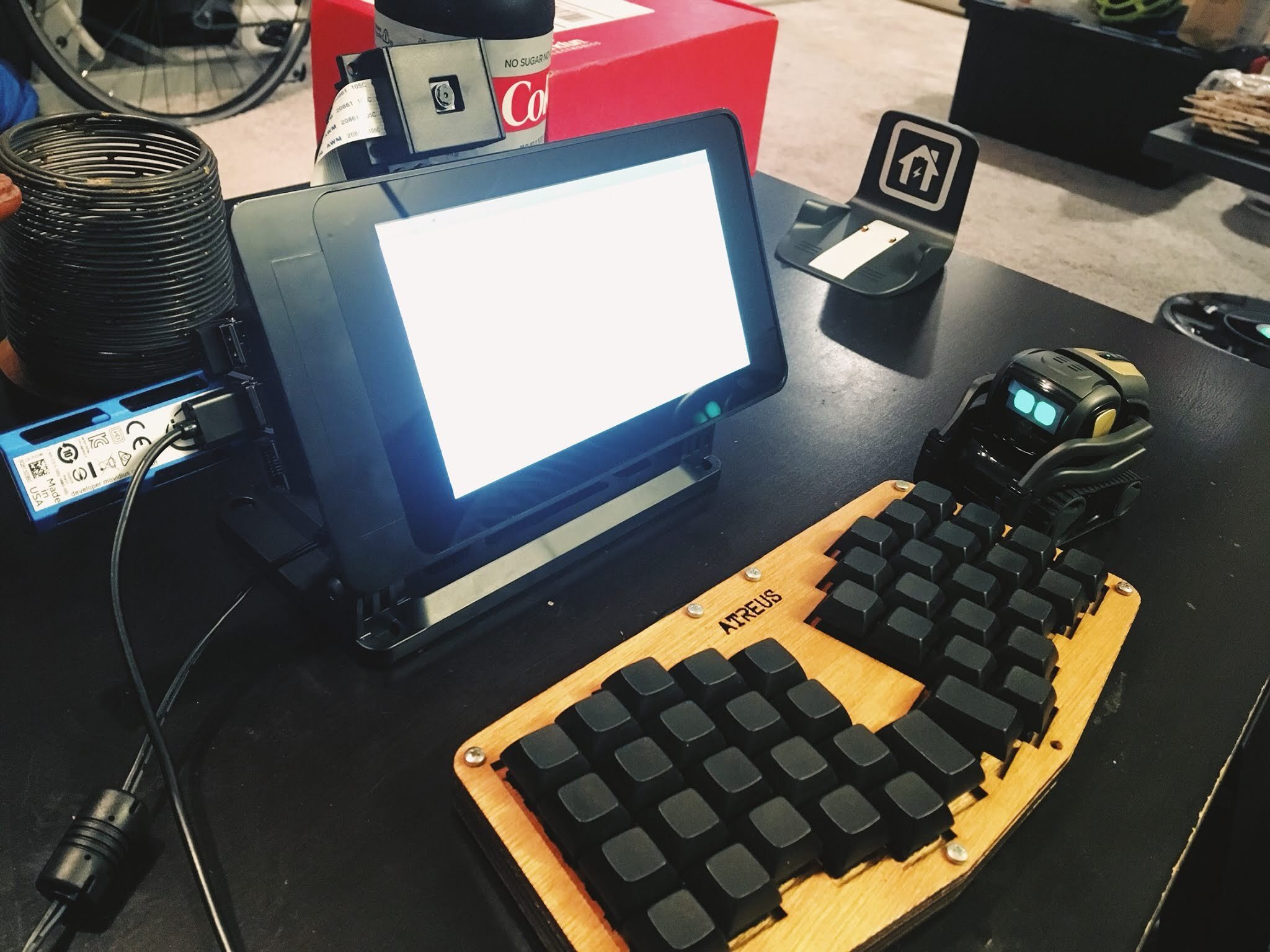
This is based around the Raspberry Pi 3B+, which was a huge pain to get setup. Ubuntu has made their Pi images pretty anti-local-user, and I had to find someone else's image linked via a forum post. I wanted Ubuntu 18.04 because A) security updates and B) ROS Melodic only supports armhf on Ubuntu. I looked at doing arm64, but that was going to be even more painful. The touchscreen just worked once I got a working Ubuntu image. A quick list of parts:
- the official Raspberry Pi touch display
- Smarticase smartipi case
- the Raspberry Pi camera module v2
- Movidius neural compute stick (we'll see how useful this ends up being)
- I'd be remiss not to mention the Atreus keyboard
My idea is to use this to maybe do some API integration with Digit (my Anki Vector), experimenting with various capabilities. I'm sort of loathe to turn it into more of a puppet than it is. I'd also use it for other experiments in neural networks (though I did order a second neural compute stick for my laptop).
The Vector has been a lot of fun; I appreciate their approach to the problem in that a "pet robot" is naturally more credible than trying to make something human. That is, I think that more progress can be made in emulating non-human intelligences now, and that it makes more sense to get a working robot that feels like it's "alive," for some sense of that word. This is admittedly all very vague and I need to sharpen my thinking here. It probably merits its own essay. Suffice it to say for this arena that Digit has been making me think a lot about HRI (human-robot interactions) and what intelligence looks like.